
How to Open a Brewery, Brewpub, Brew on Premises, Winery, Farmer-Winery, Distillery or Rectifier in Rhode Island
View & Download: Open a Brewery in Rhode Island (PDF)
Overview of a Multi-Part Permitting Process
The Rhode Island Department of Business Regulation (DBR) issues different categories of liquor licenses that fall under a three-tier licensing system: Manufacturing licenses, Wholesaler licenses, and Limited types of retail licenses. This guidance ONLY provides general information pertaining to “Liquor License Manufacturer,” which includes each of the following license types: Brewery, Brewpub, Brew on Premises, Winery, Farmer-Winery, Distillery, and Rectifier. Except for Brew on Premises, each of these license types includes some level of retail privileges. Otherwise, any other retail licensing is issued by the municipality in which the business premises is located.
Back to topOpening any of the above types of liquor manufacturing businesses in Rhode Island requires permitting with several separate regulatory bodies:
- Local towns and cities issue building, zoning, wastewater pre-treatment, other local permits, and retail liquor licenses.
- The Rhode Island Department of Health (RIDOH) issues licenses for Public Water Systems (PWS) and Food licenses.
- The Rhode Island Department of Environmental Management (DEM) issues permits for Onsite Wastewater Treatment Systems (OWTS) and registers farms, such as Farmer-Wineries.
- The Federal Alcohol and Tobacco Tax and Trade Bureau (TTB) issues the federal brewery “basic permit” as well as permits for the production of wine and distilled spirits.
- The Rhode Island Department of Business Regulation (DBR) issues liquor manufacturer and wholesaler licenses.
Although obtaining the manufacturer liquor license with the DBR is the last step a liquor manufacturer must complete before opening, all the other major licensing requirements need to be considered together before a prospective liquor manufacturing business begins the DBR application process. For example, the state requirement that a licensee business have a certificate of authority from the RI Secretary of State, that the license applicant provide notice of their application to abutting property owners within 200 feet, or that a Public Water System (PWS), wastewater pre-treatment system, or Onsite Wastewater Treatment System (OWTS) may be required should be considered threshold issues, especially considering typical liquor manufacturer investment and start-up costs. In any event, making sure the proposed business is adequately funded to cover the costs associated with a potentially long permitting process should be factored into your planning.
The information provided within this document is for general information and offered as a public service meant to give general guidance on some of the steps involved in the opening of a Brewery, Brew on Premises, Winery, Farm-Winery, Distillery or Rectifier. Each business and location is unique and therefore has its own circumstances and potential additional permitting or licensing requirements. The information presented should not be used as a substitute for professional advice or guidance. We always recommend seeking advice and assistance from professionals when venturing into a business.
Worksheet: Important Considerations When Thinking About Opening a Brewery, Brewpub, Brew on Premises, Winery, Farmer-Winery, Distillery or Rectifier
Some of the items in the following worksheet need to be considered simultaneously and not necessarily in the order listed. There are many critical factors to determine if a particular location can support your business venture, meet regulatory requirements, and/or remain within your projected budget. Please review the worksheet in its entirety so you have a better idea of the order in which you may need to address these tasks.
Water
- Where does drinking water for the location come from (see Section A)? ☐ Public water ☐ Well
- Does it meet the requirements of the Public Drinking Water regulations in order to operate your business type? [Check with the Rhode Island Department of Health (RIDOH), Center for Drinking Water Quality.] ☐ Yes ☐ No
- What are potential costs to meet the requirements? $
Wastewater
- For the location, where does wastewater go (see Section B)? ☐ City/town sewer ☐ On-site wastewater treatment system (OWTS)
- Does it meet the regulatory requirements in order to operate your business type? [Check with the Department of Environmental Management (DEM), Office of Water Resources, or your local wastewater facility.] ☐ Yes ☐ No
- What are potential costs to meet the requirements? $
- What type of wastewater pre-treatment system (e.g., grease trap, holding tank), if any, will be needed? Potential costs? $
- What type of sewer connection or wastewater discharge permits, if any, will be needed? Potential costs? $
Zoning, Liquor Licensing, and Building
- Does the location have the proper zoning and use permit for the type of business you want to operate (see Section C)? ☐ Yes ☐ No
- For a brewpub license, does the city or town have any liquor licenses available (see Section D)? ☐ Yes ☐ No (This is not applicable for a brewery, winery, rectifier, or distillery. For a brewpub you will need a local liquor license in addition to a DBR manufacturer liquor license.)
- Can your location meet the requirements for obtaining a liquor license? ☐ Yes ☐ No
- Does the building currently comply with applicable fire code(s) (see Section E)? ☐ Yes ☐ No
- Will I need a fire suppression (sprinkler) system? ☐ Yes ☐ No
- Is the sprinkler system in this location adequate? ☐ Yes ☐ No
- Is the fire alarm system in this location adequate? ☐ Yes ☐ No
- How much renovating am I willing to do (see Section F)? Potential costs? $
- What type of building permits will be needed?
- Are bathrooms adequate and do they meet Americans with Disabilities Act (ADA) requirements? ☐ Yes ☐ No
- How much seating will I need?
- Does the established maximum occupancy for this location meet my needs? ☐ Yes ☐ No
Food Service
- Will I serve food? ☐ Yes ☐ No
- If No, what infrastructure needs should I plan for now, in case I decide to serve food in the future?
- If Yes, what type of food license will I need from the RIDOH Center for Food Protection?
- Will my proposed menu or kitchen setup require kitchen exhaust hoods? ☐ Yes ☐ No. If so, what type will I need?
- Should I plan and prepare for plumbing needs now? ☐ Yes ☐ No
- Is there adequate area for dining space, kitchen space, production area, preparation areas, dishwashing area, hand sinks, storage, employee area/lockers, refrigeration, freezer, dry storage, office, and bathroom areas? ☐ Yes ☐ No
- Will serving food require that water is supplied from a public water system (PWS)? ☐ Yes ☐ No
- How will serving food alter compliance with wastewater discharge? (For example, will the warewashing area require a grease trap, or will the Onsite Wastewater Treatment System need upgrading?)
- What type of grease removal equipment will be required?
Parking, Site, and Other Requirements
- Is existing parking adequate to meet my business needs and city/town requirements? ☐ Yes ☐ No
- Are there limits on parking, such as 1-hour parking limits or meters? ☐ Yes ☐ No
- Is this a landmark building or in a historic district? ☐ Yes ☐ No
- Are there any special requirements or restrictions? ☐ Yes ☐ No
- If I want to have outdoor seating, does this location’s zoning allow outdoor seating? ☐ Yes ☐ No
- Is the location within 200 feet of a shoreline? ☐ Yes ☐ No. If so, also check with the Coastal Resource Management Council (CRMC) to see if permits or approvals for alterations from this state agency will be required.
Other Government Entities
Make sure to check with these other government entities that regulate liquor, in addition to the RI DBR:
- Municipalities: They have jurisdiction over zoning ordinances, which may affect the location of any type of liquor license and associated issues such as parking and noise.
- The Rhode Island Division of Taxation: Responsible for the collection of state taxes on alcohol in Rhode Island.
- The Federal Alcohol and Tobacco Tax and Trade Bureau (TTB): Enforces laws pertaining to federal taxation of alcohol, the federal permitting of alcohol manufacturer and wholesaler businesses, and certain rules pertaining to “trade practices” between manufacturers/wholesalers and retailers.
You must contact each of these government entities directly regarding any questions within their jurisdiction. This is not an exhaustive list, and you are encouraged to consult with an attorney and/or compliance professional.
Staffing and Training
- Which staff are required to complete Alcohol Server Training (if serving alcohol)?
- Does the seating size of my establishment require training employers and employees in basic crowd management techniques to comply with the state fire code? Where 50 or more individuals could legally assemble, establishments are required to have at least one certified crowd manager or crowd manager supervisor (see crowd management training on Section M). ☐ Yes ☐ No
Where Do I Start? Initial Critical Considerations
A. Determine the Type of Drinking Water Supply at the Location
THIS IS A CRITIAL STEP
Once you have identified a potential location, is the drinking water at the location sourced from a municipal water utility or an on-site well, and does it meet the requirements of the Public Drinking Water regulations in order to operate your establishment? Some general guidance on required drinking water supply systems follows. If a Public Water System (PWS) is required and the location cannot support a PWS, or if it may be too costly to conform or construct a new PWS, then the location may not be able to support your business endeavors.
1. City or Town Water System (Also Known as an Off-Site Public Water System, or PWS)
If the establishment is on a city or town Public Water System (PWS), this is normally an acceptable drinking water supply. You should know the name of the municipal water supply system in case you need to submit this information with any application process. You may need to show, as verification, a recent copy of the water bill with the location address or a certificate from the water supplier. Check with the Rhode Island Department of Health (RIDOH), Center for Drinking Water Quality.
2. On-Site Well
a. RIDOH-Licensed Public Water System (PWS)
If the establishment receives its water supply from an on-site well, and the well is licensed with the RIDOH Center for Drinking Water Quality as a PWS, then before you lease or purchase the property you should verify that the water supply system can support your business endeavors by providing the PWS license number to the RIDOH Center for Drinking Water Quality at [email protected] or (401) 222-6867.
b. Does Not Have a RIDOH Public Water System (PWS) License
If the establishment receives its water supply from an on-site well that is NOT a PWS of record, then contact the RIDOH Center for Drinking Water Quality for further guidance at (401) 222-6867. If you would like input from DEM and RIDOH to determine what drinking water requirements may apply to your proposed business, complete the online RIDOH/DEM Business Pre-Application Form. There is no cost to submit the pre-application form or to participate in a pre-application meeting (if applicable). While completing the form, you can use Understanding Business Preapplication Requirements for Drinking Water and Wastewater Treatment Systems as a resource.
A Public Water System (PWS) is required by law in order to operate your business if you use water for one or more of the following activities:
- Food preparation and/or washing of food contact surfaces and/or utensils
- Providing water for human consumption, such as handwashing commonly supplied in restrooms, to at least 25 users (customers and/or employees) daily for at least 60 days out of the year
- Having at least 15 service connections
The design of a PWS will require hiring a professional engineer.
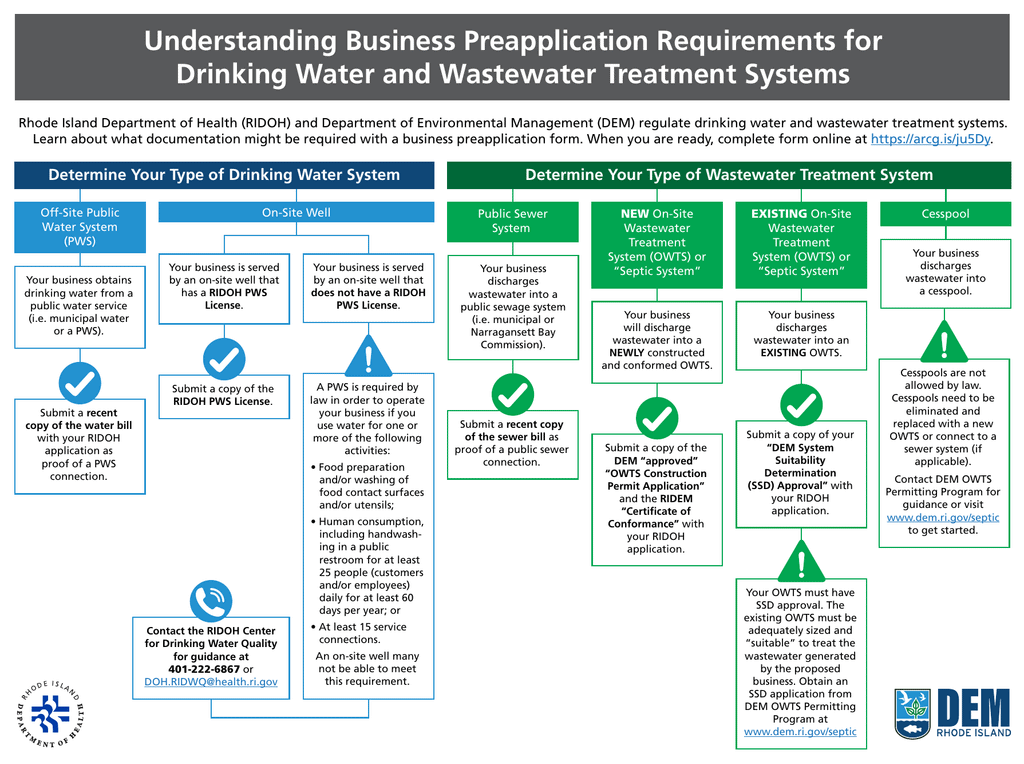
If you are trying to start a business that is not serviced by a municipal water supply system, and the on-site well is not licensed as a public water system, complete the online RIDOH/DEM Business Pre-Application Form. There is no cost to submit the form. You will receive input from RIDOH to determine what drinking water requirements may apply to your proposed business type and location. The flow chart below can help you determine your drinking water requirements when completing the form.
You can use the flow chart below as a resource to assist with determining your drinking water requirements when completing the RIDOH/DEM Business Pre-Application Form.
B. Determine the Type of Wastewater Treatment System for the Location
THIS IS A CRITICAL STEP
Is the wastewater at the business location discharging into a public sewer system or an on-site wastewater treatment system (OWTS, also known as a septic system), and does it meet regulatory requirements in order to operate your business type? Guidance on the required sewer connection permit or letter, the approved OWTS, and the need for pre-treatment of wastewater before discharge into a sewer system or OWTS follows.
1. Sewer System
If the business location is on a public sewer system, you will need to obtain approval (i.e., a sewer connection permit or letter of approval from the appropriate wastewater treatment facility). You will need to know or determine whether you are connected to a municipal sewage treatment facility or to the Narragansett Bay Commission (NBC) sewage treatment system. To inquire about a new sewer connection permit, contact or submit an application to the appropriate wastewater treatment facility.
Wastewater Treatment Facility Officials | Rhode Island Department of Environmental Management
a. Wastewater Discharge Permit
Because of the nutrient-rich discharge from these business types, it is commonly required to pretreat wastewater before it enters the sewer system. We encourage you to contact your local municipal wastewater treatment facility to learn about the specific requirements for your type of operation. The design of a pretreatment system may require hiring a professional engineer. The local sewer authority Pre-treatment Coordinator or Manager can advise you on what may be required.
Pre-treatment Program Contacts for each wastewater treatment facility (WWTF)
These coordinators would be better suited to field questions related to pretreatment and local limits.
Municipal wastewater treatment facilities, locations, and officials
2. On-Site Wastewater Treatment System (OWTS)
If the potential business is not connected to a public sewer system and you have an existing OWTS, you will need to verify that the system is suitable for your needs. You will likely need to submit a System Suitability Determination (SSD) application to the RI Department of Environmental Management (RIDEM) OWTS Program. This application process will determine whether the current system is suitable for your operation. It may require hiring a licensed OWTS designer/installer and/or a professional engineer. In addition, a wastewater pre-treatment system or holding tank is commonly recommended because of the type of wastewater discharge from these business types.
To complete a System Suitability Determination (SSD) application, visit DEM’s online Office of Water Resources (OWR) Application Portal, which includes all Groundwater and Freshwater Protection Programs. You can submit and manage applications for Freshwater Wetlands, OWTS/Septic, SSD, RIPDES, Water Quality Certification, and UIC programs at dem.ri.gov/owr-portal-login.
To request personalized support, submit a ticket at dem.ri.gov/owr-portal-ticket, email [email protected], or call (401) 222-3961.
If you are trying to start a business that is serviced by an existing OWTS, complete the online RIDOH/DEM Business Pre-Application Form. You can use the flow chart as a resource to help determine your wastewater requirements. There is no cost to submit the pre-application form. You will receive input from RIDOH and RIDEM on the requirements that may apply to your proposed business type and location with respect to OWTS.
If it is determined that a new OWTS is needed, submit an application to RIDEM for Construction of a New Onsite Wastewater Treatment System (OWTS). The design of an
OWTS would require hiring a licensed OWTS designer/installer and/or professional engineer
(see links for licensed professionals below)
RIDEM Resources
To complete a System Suitability Determination (SSD) application, visit DEM’s online Office of Water Resources (OWR) Application Portal – The SSD application process will determine if the current OWTS is suitable to support your operation. This process may require hiring a licensed OWTS designer/installer and/or a professional engineer.
- OWTS/Septic Permit Search
- OWTS Licensed Professionals | Rhode Island Department of Environmental Management (For a list of Licensed Professionals such as OWTS Installers, Designers & Soil Evaluators)
C. Check Zoning and Land/Building Use
Check with the local municipality where your business will be located to determine what municipal permits, licenses, or approvals you may need. Each municipality treats these business types differently, so check with the building and/or zoning official, the town or city planner, and possibly the town or city clerk’s office. Make sure your establishment or potential property is properly zoned for the type of use you have in mind. In addition, confirm what other licenses or permits may be needed before moving forward with any financial commitments such as lease or purchase agreements.
Note: You will need to submit a copy of the zoning inspection or approval from the town or city where your business will be located as a requirement for the application for initial licensing with the Rhode Island Department of Business Regulation (DBR) for a state Manufacturer Liquor License.
D. Check Availability of Municipal Liquor Licenses
1. If You Intend to Open a BREWPUB
In addition to a manufacturer license from DBR, brewpubs (not breweries, brew on premises, wineries, rectifiers, or distilleries) are required to obtain a Brewpub Retail License or other locally issued liquor license from the local municipality that authorizes the activities of a brewpub. This is because brewpubs are a different license type: they also have a kitchen and serve food. Many cities and towns have a limited number of liquor licenses, so in some areas you may not be able to get a new liquor license if the quota has been filled. If a new license is not available, another option might be to find a business owner who is interested in transferring their liquor license. Become familiar with your local licensing process, since obtaining a liquor license may vary by municipality, and these licenses normally include a public hearing process held by the local town or city council.
Below, we discuss some additional steps to consider prior to beginning the Brewpub Manufacturer license process with DBR:
Brewpub Additional Information
There are several statutes that apply to the licensing of brewpubs. In setting up a brewpub business, the applicant has choices on how to structure the business, the scope of activities, and which license(s) to apply for. There are essentially three licensing application choices, all of which require obtaining both state DBR and local/municipal approvals.
- Apply to DBR for a Brewpub Manufacturer License under RIGL § 3-6-1.2. DBR Rule 1.4.6(B)(8) requires local approval in the form of a RIGL § 3-7-7.2 Brewpub Retail License or other locally issued liquor license that authorizes the activities of a brewpub.
- Apply to DBR for a Manufacturers License under RIGL § 3-6-1, and apply to the city or town for a Brewpub Retail License under RIGL § 3-7-7.2.
- For maximum privileges, apply to DBR for both a Brewpub Manufacturer License under RIGL § 3-6-1.2 and a Manufacturers License under RIGL § 3-6-1; and to the municipality for a RIGL § 3-7-7.2 Brewpub Retail License or other locally issued liquor license that authorize the activities of a brewpub).
Note: Breweries (RIGL § 3-6-1) that do not operate as brewpubs do not require any specific local liquor license.
2. If You Intend to Open a Brewery, Brewpub, Brew on Premises, Winery, Farmer-Winery, Distillery, or Rectifier
You will need to obtain a Manufacturer’s license (or, for a rectifier, a Rectifying Manufacturing license) from the DBR. The Manufacturer’s license authorizes the holder to establish and operate a brewpub, brew on premises, winery, farmer-winery, or distillery at the place described in the license for the manufacturing of beverages within this state.
A Rectifying Manufacturing license authorizes the holder to engage in the business of rectifying and blending at the location described for the rectifying, purifying, refining, blending, warehousing, and bottling of distilled spirits and wines.
Below, we discuss other steps you need to consider before applying for any of these state manufacturing licenses.
E. Determine if the Location/Building Complies with Fire Code Requirements
Check requirements with the local Fire Marshal in the town or city where your business will be located. You may also consider hiring a professional for assistance in meeting fire code requirements. Verify whether you will need to install or upgrade the sprinkler system, fire alarm, or the exhaust hood system over the stove (if you plan to have a commercial kitchen).
Note: You will need to submit a copy of the fire inspection/approval from the local fire marshal in the town or city where your business will be located as a requirement for the application for initial licensing with the DBR for a state Manufacturer Liquor License.
F. Determine if the Building Complies with Building Code Requirements
Do you need building permits for alterations or a change in land use or building use?
Remember a building permit is required for minor interior alterations, remodels, or new construction. Always check with the local Building Official about what permits might be required. Also keep in mind, if the property already has a PWS then any addition or building within 200 feet or a 400-foot radius of the public well is prohibited. If you need additional information on land use, building codes, and which requirements apply to you, consider hiring an architect, engineer, or other building professionals for help.
If the location previously served as a retail store or was used for some other purpose, you may need to record a “change of use” with the local city or town where the building is located. Visit the city or town hall to determine whether a “change of use” filing is necessary and to obtain the proper forms and procedures.
G. Determine If You Will Serve Food
If you plan to serve food in your establishment, you will need a Food Business License issued by the Rhode Island Department of Health (RIDOH) Center for Food Protection (CFP). The specific license(s) you may need depend on your food concept, menu, population served, and food preparation process. It is recommended that you contact CFP at (401) 222-2749 for assistance.
Even if you are not planning to serve food immediately, you may want to serve food in the future as we are finding with other establishments. Therefore, it may be worth having a conversation with CFP staff and RI DEM, Water Resources OWTS staff to determine what infrastructure you can address now while in the early stages, to alleviate additional costs down the road. For example, you may want to put in the necessary plumbing for a hand sink or three bay sink and grease trap removal equipment while you make building modifications because it may cost more to re-do things once your renovation is completed.
Victualing license: Pursuant to RIGL § 5-24-1, a “victualing house” is a business where food is prepared and/or consumed on the premises. A municipality has the power to regulate such an operation by granting a license. Contact the municipality where your establishment will be located to inquire whether a victualing license is required. You may need a victualing license from the municipality in addition to a Food Business License from RIDOH.
Notes:
- If you serve food, you must obtain a Food Business License(s) from the RIDOH Center for Food Protection. Serving food in an establishment without the proper Food Business Licenses from RIDOH is not allowed.
- If you serve food, animals are not allowed in the establishment, with the exception that service dogs are allowed in the facility per the ADA.
- As an alternative to preparing food on the premises, licensed mobile food establishments (MFEs) may be on the property for customers to purchase food, provided each MFE holds a valid license issued by RIDOH. Ensure that any MFEs that intend to sell food on your property are licensed with the RIDOH Center for Food Protection.
H. Determine What’s Needed to Comply with the RI Division of Taxation
Depending on your type of liquor manufacturing operation and the types of business operations you conduct on the premises, you may be subject to various taxes, such as sales and excise taxes, alcohol import taxes, meals and beverages taxes, and quarterly income taxes. We urge you to contact the RI Division of Taxation for guidance, or to work with a professional tax advisor or Certified Public Accountant (CPA) to register your business and meet all of your potential tax obligations.
You will most likely need to register your new business with the RI Division of Taxation by completing the Business Application and Registration (BAR) form. This is a comprehensive application used to register businesses for the following: Permit to make sales at retail (if applicable), income tax withholding account, RI unemployment insurance account (including Rhode Island temporary disability insurance (TDI) and Rhode Island job development fund tax), etc. To reiterate, contact your tax professional for assistance with complying with the RI Division of Taxation requirements for your business type.
Tax Resources
- RI Division of Taxation: https://tax.ri.gov/
- Online Business Application for Registration (BAR form): https://tax.ri.gov/resources/businesses/registration
- Statute: R.I. Gen. Laws § 3-10, Taxation of Beverages
- Contact information for Excise Tax Section – (RE: Alcohol Import Tax)
Email: [email protected]
Webpage: Sales & Excise Taxes | RI Division of Taxation
Phone: 401.574.8955 - Contact information for Compliance and Collections Section
Email: [email protected]
Phone: 401.574.8941 - The Restaurant Industry and Rhode Island Tax Guide (Revised 9-26-23 PDF)
The sale of food and beverages (both alcoholic and nonalcoholic) are subject to certain RI taxes. This is a helpful guide for businesses created by the RI Division of Taxation.
I. Requirements for the Initial Application for a State Liquor Manufacturer License with DBR
Once you have addressed the more critical and costly items mentioned above, it is time to complete the Manufacturer Licensing application.
The following items must be submitted with your DBR liquor manufacturer license application
- Complete the DBR Initial Wholesaler/Manufacturer License online at https://ridbrprod.state-reg-eastern.tylerapp.com/portal/public.
- For a copy of the application, click here: https://dbr.ri.gov/sites/g/files/xkgbur696/files/2023-08/WholesalerManufacturerInitial_0.pdf
- Copy of zoning inspection/approval from the city/town your business is located.
- Sign and submit the Taxpayer Status Affidavit, which is a document included with the DBR initial application as Exhibit 1.
- Submit a Criminal History Record (CHR), with each DBR Liquor Application. A Criminal History Record may be obtained by visiting the Bureau of Criminal Identification at the Rhode Island Department of Attorney General, 4 Howard Avenue, Cranston, RI 02920. To apply for a CHR in person, bring a picture-identification, showing your date of birth. The cost is five dollars ($5.00) at the time of this publication.
- The applicant must submit a copy of the Federal Basic Permit with the DBR application. This permit can be obtained from the Federal Tax & Trade Bureau at the National Revenue Center, Cincinnati, OH by using their Permits Online platform at: https://www.ttb.gov/online-services/ponl/customer-support
J. Requirements for the Federal License
If you are applying for a DBR manufacturer liquor license, you will need to submit a copy of the applicable federal permit issued by the Federal Tax & Trade Bureau (TTB) as a requirement for the application for initial licensing with the DBR. As stated earlier, this permit can be obtained from the TTB National Revenue Center in Cincinnati, OH, through its Permits Online platform at https://www.ttb.gov/online-services/ponl/customer-support. For more information on the permit application process, contact the TTB National Revenue Center (NRC) toll-free at 877-882-3277 (877-TTB-FAQS) or submit an online inquiry. For technical assistance with Permits Online, see the TTB Online Help Center.
Note: All questions about the federal process and timeline should be directed to the federal agency, Federal Tax & Trade Bureau (TTB).
Online help center: https://www.ttb.gov/onlineservices/ponl/customer-support
K. Registration of Farmer-Wineries with the RIDEM Division of Agriculture and Forest Environment (DAFE)
Pursuant to RI Code of Regulation 250-RICR-40-00-2 (Produce Safety Rule), if you operate a farmer-winery in Rhode Island, you will need to register with the Rhode Island Department of Environmental Management (DEM) Division of Agriculture and Forest Environment (DAFE) as a farm and also comply with any applicable alcohol licensing requirements with the RI Department of Business Regulation (DBR).
DAFE Registration Process
- Use the DAFE Permit Application Portal
dem.ri.gov/dafe-portal Rhode Island Department of Environmental Management. - Understand “Farmer” Status
DEM defines a “farmer” broadly to include those engaged in agricultural production, including wine production from grapes grown on the farm. If your winery produces wine from grapes grown on your property, you may qualify as a farmer under DAFE’s definition. - Contact DAFE for assistance
For DAFE-related questions, call 401-222-2781 or visit the portal’s User Guides & FAQs for step-by-step help. Rhode Island Department of Environmental Management+1.
L. General Information and Citations for the Classes of Liquor Licenses Issued by DBR
Manufacturer’s License
Authorizes the holder to establish and operate a brewery, brewpub, winery, distillery, or farm-winery at the place described in the license for the manufacture of beverages within this state. Separate licenses are required for each plant location. (RIGL § 3-6-1)
See license types below:
- Brewery: A business that may sell the products it makes on-site directly to consumers, subject to the limitations on amounts set in the statute. (RIGL § 3-6-1)
- Brewpub (not a brewery, winery, rectifier, or distillery): Also permitted to sell products directly to consumers, subject to statutory limitations. (RIGL § 3-6-1.2) Brewpubs also require local municipal licensing, such as a Brewpub Retail License (RIGL § 3-7-7.2) or other locally issued liquor license that authorizes the activities of a brewpub.
- Brew on Premises (BOP): Authorizes the holder to provide brewing supplies and facilities to the public for the private manufacture of malt beverages on the licensed premises. (RIGL § 3-7-7.4) Unlike the other manufacturer license types, BOP licenses do not include retail privileges.
- Distillery: A business that may sell the products it makes on-site directly to consumers, subject to the limitations on amounts set in the statute. (RIGL § 3-6-1)
- Farmer-Winery: May sell the wine made on-site in its tasting room and has expanded privileges. However, farmer-wineries must follow certain in-state ingredient sourcing requirements to qualify for this privilege. (RIGL § 3-6-1.1)
- Winery: A winery may not sell alcohol directly to consumers, but may only sell it to a wholesaler for distribution. (RIGL §§ 3-6-1, 3-6-16)
- Rectifying: A rectifier cannot sell directly to consumers. (RIGL § 3-6-6)
For more information see:
Information Sheet: Classes of DBR-Issued Liquor Licenses at https://dbr.ri.gov/sites/g/files/xkgbur696/files/documents/divisions/commlicensing/liquor/ Info_DBRIssuedLiquorLicenses.pdf
M. Resources
RIDOH/RIDEM Business Pre-Application Form
This pre-application process is for applicants who want to start a business that is not serviced by a municipal water system and/or a public sewer system. Applicants complete this online form and then a pre-application meeting (if applicable) is scheduled with staff from RIDEM and RIDOH. There is no fee for this pre-application meeting.
What Is a Public Water System (PWS)?
A facility or establishment that uses water in food preparation and/or for washing food contact surfaces and/or utensils, or that provides water for human consumption, such as water for handwashing commonly supplied in public restrooms, to at least 25 users (customers and/or employees) daily for at least 60 days out of the year, or that has at least 15 service connections.
Rhode Island Department of Health, Center for Drinking Water Quality
The RIDOH Center for Drinking Water Quality prevents disease and protects and promotes the health and safety of the people of Rhode Island by ensuring the quality of the state’s drinking water supply. It monitors public drinking water quality and approves new public water sources and systems (PWS). For assistance, call (401) 222-6867.
Rhode Island Department of Health Center for Food Protection
The RIDOH Center for Food Protection regulates food establishments through licensing, inspections, and plan reviews. For assistance, call (401) 222-2749.
Rhode Island Department of Environmental Management (DEM), Onsite Wastewater Treatment System (OWTS) Program
The DEM OWTS Program administers Rhode Island’s septic system permitting program to protect public health and the natural environment, with a focus on customer service. DEM staff provide regulatory oversight in three main stages of the septic system permitting process:
- Site suitability: A preliminary stage that assesses the suitability of a parcel of land for on-site sewage treatment.
- Treatment system design review: Determines a design’s compliance with state standards, rules, and regulations.
- System installation: DEM staff conduct field inspections during key stages of system siting and installation.
For assistance, contact OWTS Program staff at [email protected] or (401) 222-3961.
DEM Guidance for Breweries, Wineries, Distilleries, etc.
Below is a list of PDF resources for handling wastewater from breweries, wineries, and distilleries:
- Wastewater Disposal Guidance for Breweries, Wineries & Distilleries
- Industry Pretreatment Program Factsheet for Breweries, Wineries, Distilleries
- Solid Waste Guidance for Breweries, Wineries & Distilleries
- Rhode Island Outlets for Brewer Solid Waste
Wastewater Treatment Facilities/Locations and Officials in Charge
DEM created a list of municipal wastewater treatment facilities and contact information – handy for people who want to open a brewery and need to figure out which sewer system they are connected to and who they need to work with on their wastewater discharge into that system.
DEM RI Green Certification Programs
This is a voluntary program developed to assist businesses across various categories to become sustainable and to continuously improve their pollution prevention performance. The intent of these voluntary programs are to encourage reduction of toxic substances, reduce the generation of hazardous waste whenever technically and economically practicable, reduce the use of single use plastics, increase the rates of commercial recycling, reduce sources of water pollution, reduce water usage, and educate customers and business owners about sustainability.
To learn more about the brewery green certificate program:
https://dem.ri.gov/environmental-protection-bureau/customer-and-technical-assistance/green-certification-programs-green-brewery.
Rhode Island Department of Business Regulation (DBR)
The DBR Division of Commercial Licensing has regulatory oversight of the manufacture, import, export, storage, sale, and transportation of alcoholic beverages. The Department issues licenses to manufacturers (breweries, distilleries, wineries, rectifiers), wholesalers, marine vessels, railroads, airplanes, and Class “P” caterers. All other liquor license types are considered retail licenses and are issued by the city or town where the business is located.
The Commercial Licensing Division reviews applications, assesses and collects fees, conducts inspections, investigates complaints, and carries out enforcement with respect to regulated entities. For assistance with liquor licensing, contact DBR’s Commercial Licensing Division staff through the Online Inquiry System, by email at [email protected], or through the DBR website.
DBR Application for INITIAL Wholesale/Manufacturer License:
Avoid the paper pile up – Apply for your license online at: https://ridbrprod.state-reg-eastern.tylerapp.com/portal/public.
Rhode Island Office of the State Fire Marshal: Crowd Management Training
The NFPA 101 Life Safety Code requires all places of assembly (where 50 or more individuals could legally assemble) to have at least one certified crowd manager or crowd manager supervisor. This applies to restaurants, breweries, and similar establishments. This program trains employers and employees in basic crowd management techniques to comply with the state fire code.
Individuals who successfully complete a crowd management training session are issued a five-year license from the State Fire Marshal’s Office.
For assistance, email Training Officer Anthony Lancellotti at [email protected] or call the RI State Fire Marshal’s Office at (401) 889-5555.
Rhode Island Brewers Guild (Independent Service)
The Rhode Island Brewers Guild is the official brewery association in Rhode Island, existing to support and promote Rhode Island craft breweries. Visit ribrewersguild.org for membership information, or email [email protected].
Liquor Control Administration Regulation
DBR Regulation 230-RICR-30-10-1, Liquor Control Administration.
Alcohol Server Training Certification (If Serving Alcohol)
A Manufacturer whose license authorizes retail sales and service must demonstrate compliance with the alcohol server training regulations, as promulgated by the department of business regulation. All persons who sell or serve alcoholic beverages; anyone serving in a supervisory capacity over those who sell or serve alcoholic beverages; anyone whose job description entails the checking of identification for the purchase of alcoholic beverages; and valet parking staff shall receive alcohol server training. To obtain a server permit, individuals must successfully complete a RI Certified Alcohol Server Training Program. For a list of approved training programs go to Liquor Enforcement and Compliance | Dept. of Business Regulation and select the dropdown menu for “Licensed Liquor Entities” (Including Certified Alcohol Server Training Programs).
List of municipality websites
Federal Tax & Trade Bureau (TTB): Federal Basic Permit
All questions about the federal process and timeline should be directed to the Federal Tax & Trade Bureau (TTB).
Online help center: https://www.ttb.gov/online-services/ponl/customer-support